

Get Involved
The first three years of life represent a period of unparalleled plasticity. The WILD Lab studies the behavioral and neural systems that allow infants to learn from and adapt to their environments — and how those systems are shaped by contextual experience to influence cognitive and emotional wellbeing across the lifespan.
We take an ecological approach, exploring how caregiving, sensory environments, socioeconomic factors, and early biological processes dynamically interact to shape children's capacity to learn and thrive.
How does the infant brain learn to learn?We examine how early attention systems and prefrontal cortex development support flexible learning, generalization, and the foundations of lifelong self-regulation.
Early experiences - especially the home environment and parent-child interactions - are powerful influences on early development. We examine how these everyday experiences scaffold brain and behavioral development.
We study how maternal mental health, stress, and physiological wellbeing during pregnancy and the postpartum period shape infant neurodevelopment and the transmission of risk and resilience across generations.
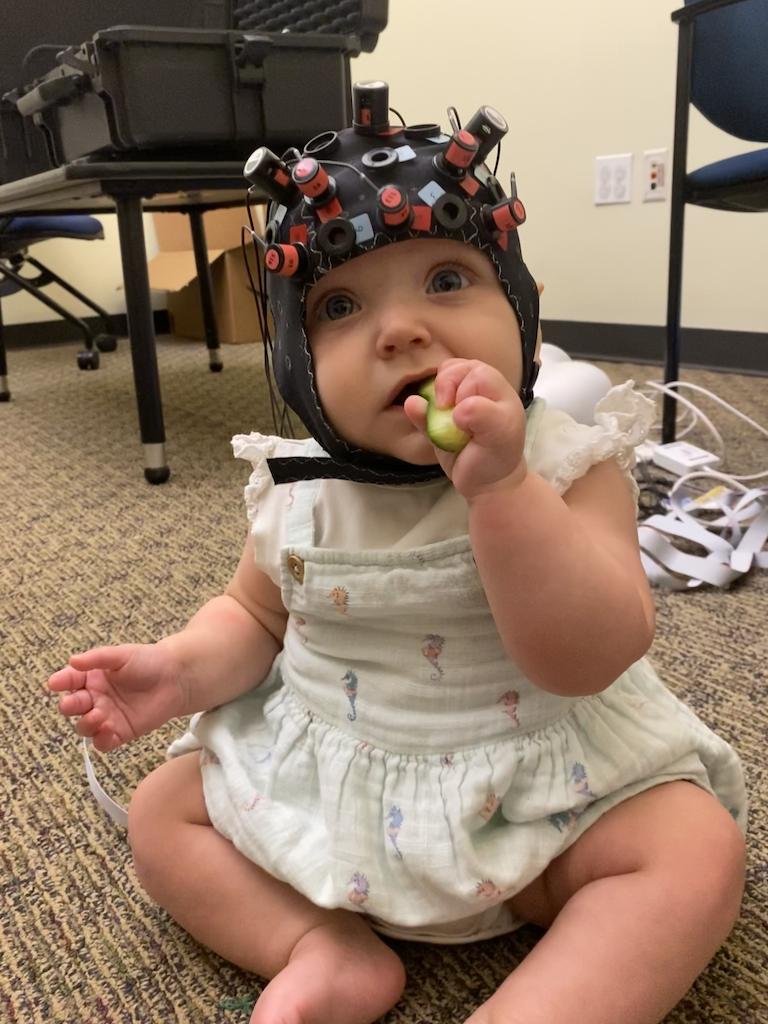
In our research, we use a variety of tools to capture the richness of infant development — in the lab, at home, and in communities.. These include observations (like questionnaires and watching parent-child interactions) and experiments (such as task-based activities). We also use infant-friendly neuroimaging techniques and measures of physiology (like heart rate) to answer complex questions about how humans develop.
We measure where infants look — a window into attention, learning, and memory before children can speak. We use both lab-based and remote webcam eye tracking (OWLET) to study gaze across diverse settings.
We use non-invasive, infant-friendly technologies, like functional near-infrared spectroscopy (fNIRS) and electroencephalography (EEG), to observe the developing brain in action.
We use wearable ECG sensors to measure heart rate variability — a sensitive index of how the autonomic nervous system regulates emotion and stress — in both mothers and infants.
We collect naturalistic measurements in the home, using techniques like webcam eye tracking and remote assessments, to capture development as it actually unfolds in the real world — not just in the lab.
Too much of what we know about child development comes from narrow, convenience samples. We are committed to changing that — by building tools, methods, and partnerships that bring developmental science to families who have historically been left out of the research conversation. This commitment isn't peripheral to our science. It improves it. Greater diversity means richer data, more generalizable findings, and discoveries that can actually serve all children.
We actively recruit from racially, ethnically, and socioeconomically diverse communities to ensure our science is representative of all families. We also use participatory research strategies to ensure our work reflects and amplifies the voices of the families in our communities.
Too often, traditional lab-based assessments create barriers to participation — especially for families in rural or geographically isloated communities. We develop new remote assessment tools that let families participate on their own terms, from anywhere in the world.
We are actively recruiting pregnant women in Orange County to participate in a new longitudinal study examining how maternal and infant physiology shapes dyadic mental health outcomes and early child development.
Nearly 1 in 5 people in the US will experience major depression — and the perinatal period is one of the most vulnerable windows. This study tracks how the body's stress-regulation systems and dyadic physiology changes over the early postpartum period, and what those changes tell us about risk for postpartum depression and early child outcomes.

UC Irvine & Orange County communities. Most components are done from home using wearable devices and smartphone apps.
Participation begins around 36 weeks of pregnancy, and involves completing short weekly questionnaires and wearing a Fitbit.
.svg)
Wearable heart monitors, short questionnaires, and brief behavioral visits at 3 & 6 months. Compensation up to $300.
We're looking for pregnant individuals in the Orange County area who are interested in contributing to science that could help families for generations. Participation is flexible, family-centered, and deeply valued.